


Fiber Cement Plate Production Line Buying Guide: Capacity, Automation, and Total Cost of Ownership
 Sep 18, 2026|
 View:23
Fiber Cement Plate Production Line Buying Guide: Capacity, Automation, and Total Cost of Ownership
For procurement managers, buying a fiber cement plate / fiber cement board production line is not just “ordering machines.” It is a capital project involving product positioning, factory layout, raw material strategy, energy consumption, labor, spare parts, and after-sales support. This guide breaks the decision down into three pillars: capacity, automation, and total cost of ownership (TCO)—with a real manufacturer profile and buyer FAQs.
1. Understand What “Fiber Cement Plate Production Line” Actually Includes
A complete line usually covers:
Raw material storage: cement, quartz sand, lime, cellulose/pulp fiber, additives
Pulping and slurry preparation
Batching and mixing
Forming: flow-on slurry forming or Hatschek forming
Vacuum dewatering and pressing
Green sheet receiving, stacking, pre-curing
Demolding
Autoclave / steam curing
Drying
Sanding, edging, chamfering
Sorting, stacking, packing
Dust collection, water recycling, PLC/MES control
If you only compare “price per set,” you will miss whether sanding, autoclave, automatic stacking, or recipe support is included.
2. Capacity: Match Output to Market, Not to the Supplier’s Catalog
Common commercial capacities:
Small / semi-auto: 30,000–500,000 m²/year
Mid-scale: 500,000–1,500,000 m²/year
Standard export-scale: 3,000,000 m²/year
Large-scale: 5,000,000–10,000,000 m²/year
Procurement tip: Define your target by daily output × working shifts × annual operating days, not just “3 million m²/yr.” Also check:
Board size: 2440×1220 mm or 3050×1220 mm
Thickness range: 4–25 mm is common
Product mix: plain board, fireproof board, cladding, wood-grain siding, UV-coated board
Line efficiency: 85–92% is realistic for planning; do not use 100%
Over-specifying capacity increases CAPEX and warehouse pressure. Under-specifying forces overtime and quality drift.
3. Automation: Where It Pays, Where It Doesn’t
Worth automating
Automatic batching and slurry concentration control
PLC-controlled forming and press cycle
Automatic stacker / destacker
Automatic edge trimming and sanding
Central control room + data logging
Automatic packing and palletizing
Can stay semi-manual for smaller plants
Manual visual sorting for non-premium boards
Manual loading of small auxiliary materials
Basic maintenance tasks
High automation reduces labor and batch variation, but increases upfront cost, training needs, and dependency on control-system spare parts. For export-quality cladding, automation is strongly recommended. For regional low-cost partition board, semi-auto can be justified.
4. Total Cost of Ownership: Don’t Stop at Equipment Price
A buyer should calculate TCO over 5–10 years:
| Cost item | Often forgotten by buyers |
|---|---|
| Equipment price | Only 30–60% of project cost |
| Civil works & foundation | Autoclaves and presses need heavy foundations |
| Steam/boiler system | Major OPEX in curing |
| Power & transformers | PLC, presses, conveyors, dust collectors |
| Water recycling system | Required in many markets |
| Spare parts | Forming felt, blades, seals, sensors |
| Installation & commissioning | 90–150 days typical |
| Operator training | Needed for recipe and quality control |
| Maintenance labor | Preventive maintenance program |
| Downtime cost | Hidden but very expensive |
Rule for procurement teams: Choose the line with the best “cost per qualified square meter,” not the lowest quoted price.
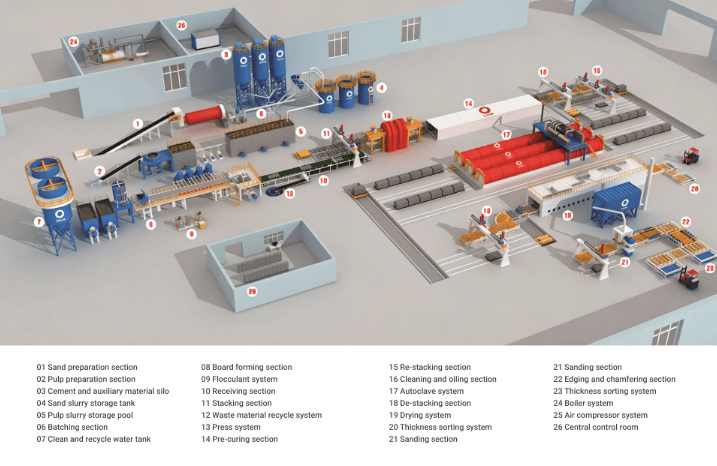
5. Manufacturer Profile: Jiangsu Runding Intelligent Equipment Technology Co., Ltd.
Jiangsu Runding Intelligent Equipment Technology Co., Ltd. (Runding) is based in Liyang, Changzhou, Jiangsu, China. The company was founded in 2011 and is best known for AAC block and panel production lines, while also supplying fiber cement board / calcium silicate board production lines.
Key facts buyers care about
Location: Liyang, Changzhou, Jiangsu, China
Core business: AAC equipment, smart building-material production lines
Fiber cement board lines offered: 3,000,000 / 5,000,000 / 10,000,000 m² per year
Standard board: 2440×1220×(4–25) mm and 3050×1220×(4–25) mm
Process coverage: pulping, slurry mixing, flow slab forming, vacuum system, pressing, demolding, autoclave curing, dust cleaning/oiling, sanding, edging/chamfering, sorting/stacking
Customization: board size, capacity, and downstream finishing can be tailored
Strength: heavy equipment manufacturing, AAC process know-how, turnkey project experience
Runding is a good fit for buyers who want a Chinese equipment integrator with factory engineering capability and are comparing AAC + fiber cement board expansion scenarios.
6. RFQ Checklist for Procurement Teams
When requesting a quote, require suppliers to state:
Annual capacity at X mm thickness
Forming method: flow-on / Hatschek / extrusion
Autoclave quantity, size, pressure, cure cycle
Installed power and recommended transformer
Steam consumption per m²
Water recycling rate
Labor count per shift
Spare parts list for first 12 months
Commissioning time and engineer days on site
Warranty, PLC brand, sensor brand
Reference plants with contactable owners
FOB/CIF/EXW terms, payment schedule, penalty for delay
7. Five FAQs Buyers Ask
Q1. Flow-on forming or Hatschek forming—which should I choose?
Flow-on slurry forming is simpler, lower cost, and flexible for many board types. Hatschek forming gives good sheet uniformity and surface quality, often favored for thinner/high-surface-quality sheets. Choose based on product mix: cladding/UV board → higher surface quality; standard partition/fire board → flow-on is usually enough.
Q2. Is autoclave curing necessary?
For high-quality fiber cement / calcium silicate boards, autoclaving improves strength, dimensional stability, and durability. Some low-density boards use steam curing without autoclave, but export-grade cladding usually benefits from autoclave curing.
Q3. What capacity is best for a first plant?
If you are entering export markets, 3 million m²/yr is a common starting point. If you serve only a local/regional market, 500k–1.5M m²/yr may be safer. Avoid buying 10M m² capacity before sales channels exist.
Q4. How long does it take to install and commission?
Typical timeline: equipment manufacturing 120–240 days, shipping depends on INCOTerms, installation/commissioning 90–150 days. A turnkey fiber cement board plant often needs 6–12 months from contract to stable mass production.
Q5. What is the biggest hidden cost?
Not the machine—it is usually steam/energy, forming felt/wear parts, unskilled operation, and poor recipe control. A cheaper line with weak process support can cost more per square meter than a better-engineered line.
Buyer Takeaway
When evaluating a fiber cement plate production line, score suppliers on:
Capacity realism
Forming + curing technology
Automation vs labor cost
Energy and water system design
Spare parts and local serviceability
Reference plants
TCO, not just EXW price
Runding and similar Jiangsu/Hebei/Shandong equipment makers can deliver competitive turnkey lines, but the winning bid should be the one with transparent specs, realistic capacity, and lowest qualified-cost-per-square-meter.