


TOP 10 Autoclaved Aerated Concrete (AAC) production line manufacturers
 Apr 16, 2026|
 View:751
Autoclaved Aerated Concrete (AAC) has revolutionized the construction industry. As a green building material, it offers a unique combination of lightweight properties, thermal insulation, and structural integrity. For investors and manufacturers, understanding the aac blocks manufacturing machinery behind this material is crucial. Choosing the right autoclaved aerated concrete machine and selecting reliable autoclaved aerated concrete manufacturers are key steps before investing in an autoclaved aerated concrete plant. This article explores what an AAC production line is, the science behind the material, the key aerated concrete production machinery involved, and a look at the top manufacturers in the market.
1. What is an Aerated Concrete Production Line?
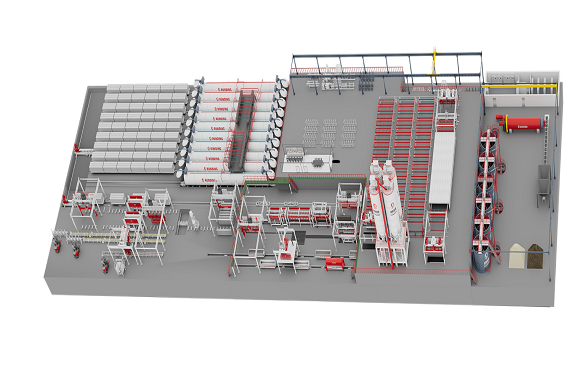
An autoclaved aerated concrete plant (also called an AAC production line) is a complex industrial system designed to manufacture AAC blocks and panels. Unlike traditional concrete production, which focuses on compaction, an AAC line focuses on aeration (creating air bubbles) and autoclaving (high-pressure steam curing).
The line integrates multiple stages: raw material processing, batching and mixing, molding (casting), pre-curing, cutting, and finally, autoclaving. Modern lines are increasingly automated, utilizing PLC (Programmable Logic Controllers) or DCS (Distributed Control Systems) to monitor parameters like temperature, pressure, and mixing ratios in real-time to ensure consistent quality.
2. What is Autoclaved Aerated Concrete (AAC)?
Autoclaved Aerated Concrete (AAC) is a lightweight, precast building material made from a mix of silica-based material (sand or fly ash), lime, cement, water, and an expanding agent (usually aluminum powder).
The Science of AAC
When water is added to the mix, the aluminum powder reacts with the calcium hydroxide in the slurry to form hydrogen gas. This gas expands the volume of the raw mix, creating millions of tiny, non-connected air pores. The volume of the raw mix can double during this "rising" phase.
Once the material sets, it is cut and placed in an autoclave—a large pressure vessel. Here, it is cured at high temperatures (180–200°C) and pressures (10–12 bar) for 8–12 hours. This process creates strong calcium silicate hydrate bonds, giving AAC its high strength despite its low density.
3. What is the Difference Between AAC and ALC?
The terms AAC and ALC are often used interchangeably, leading to confusion. Here is the technical distinction:
AAC (Autoclaved Aerated Concrete): This is the general term for the material in all its forms, including blocks (masonry units) and panels (slabs).
ALC (Autoclaved Lightweight Concrete): This term is often used specifically to refer to AAC Panels or Boards. While AAC blocks are used for masonry (laying like bricks), ALC/panels are used as structural or non-structural walls, floors, and roofs. They often contain steel bar reinforcement for added tensile strength.
In summary: All ALC is AAC, but not all AAC is ALC. AAC is the family name; ALC usually refers to the reinforced, panel-shaped members of that family.
4. Autoclaved Aerated Concrete Blocks Manufacturing Process
The manufacturing process is a precise ballet of chemistry and mechanics, Operating a profitable autoclaved aerated concrete plant requires a well-designed process executed by a high-quality autoclaved aerated concrete machine system, typically following these steps:
Raw Material Preparation: Raw materials like sand or fly ash are crushed and ground into a fine powder using a Ball Mill. This increases the surface area for the chemical reaction.
Batching & Mixing: Ingredients are weighed with high precision (error ≤ ±0.5%) and mixed with water and aluminum powder in a Mixer. The mixture turns into a slurry.
Casting & Rising: The slurry is poured into molds. The chemical reaction begins, causing the slurry to rise (aerate) and fill the mold.
Pre-curing: The molds sit in a controlled environment (the pre-curing chamber) where the "green cake" gains initial strength.
Cutting: Once firm, the cake is de-molded and cut into precise blocks or panels using high-tension steel wires. Modern cutters can achieve accuracy within ±1 mm .
Autoclaving: The cut blocks are loaded into autoclaves. The high-pressure steam cures the concrete, completing the chemical hardening process.
Packaging: Finished blocks are packaged and stored for distribution.
5. Key Structure and Functions of AAC Block Making Machine
The "autoclaved aerated concrete machine" is not a single machine but a series of interconnected equipment commonly referred to as an AAC block making machine or autoclaved aerated concrete plant machinery. Here are the key components:
Jaw Crusher & Ball Mill: These are the primary preparation machines. The Jaw Crusher breaks down large lumps of lime or gypsum, while the Ball Mill grinds siliceous materials (sand/fly ash) into a fine powder necessary for reactivity .
Batching and Mixing System: This is the heart of the plant. The Batching System uses electronic scales and screw feeders to ensure the recipe is exact. The Mixer (often a twin-shaft forced mixer) ensures a homogeneous slurry .
Molds and Casting Equipment: High-strength steel molds hold the slurry. Some systems use hydraulic pouring carts to move along a track, filling multiple molds sequentially .
Cutting Machine: This machine uses steel wires to slice the pre-cured cake. A Tilting Hoister often turns the cake 90 degrees to allow for easier cutting. Precision cutting ensures the blocks fit together perfectly on a construction site .
Autoclave: A massive cylindrical pressure vessel (often 2.68m in diameter and 32m long). It is the most critical equipment for determining the final strength of the blocks.
6. How to Choose the Right AAC Block Manufacturing Machine
Selecting the right autoclaved aerated concrete machine is a significant investment. Working with experienced autoclaved aerated concrete manufacturers ensures better after-sales support and plant customization. Consider these seven factors:
Production Capacity: Determine your target output (e.g., 50,000 m³/year). The aac blocks manufacturing machinery must match this scale .
Automation Level: Fully automatic lines reduce labor costs and human error but have higher upfront costs. Semi-automatic lines are more affordable but require more manual intervention .
Raw Materials: Ensure the aerated concrete production machinery (specifically the ball mill and batching system) can handle your specific raw materials (sand vs. fly ash) .
Cutting Precision: Look for autoclaved lightweight concrete machines with CNC control and high-precision cutting capabilities (±1mm to ±2mm) to ensure market competitiveness .
Energy Efficiency: AAC production is energy-intensive. Look for features like waste heat recovery systems that can reduce fuel consumption by 8-12% .
After-Sales Support: AAC plants require regular maintenance. Choose a manufacturer that provides spare parts and technical support readily .
Durability: The equipment deals with abrasive materials. Ensure the autoclaved lightweight concrete machines use wear-resistant liners and high-quality steel.
7. Top 10 AAC Production Line Manufacturers
Below are the world's leading autoclaved aerated concrete manufacturers, supplying complete autoclaved aerated concrete plants and autoclaved aerated concrete machines worldwide: The global market for aac blocks manufacturing machinery is dominated by German engineering and rapidly advancing Chinese technology. Here are some of the top players globally:
Global Leaders
Masa GmbH (Germany): A world leader known for high-end, fully automatic plants and excellent technology.
Wehrhahn GmbH (Germany): Specializes in complete AAC plants, known for their "System Wehrhahn" which focuses on efficiency and sustainability.
WKB Systems (Germany): Offers comprehensive solutions for AAC blocks and panels, emphasizing modernization and digitalization.
SKM GmbH (Germany): Known for innovative solutions in the AAC sector.
Xella International (Germany): The inventor of Ytong (a famous AAC brand), they possess deep proprietary technology
Asian Market Leaders
Keda (China): One of the largest manufacturers of building material machinery in China, offering robust AAC solutions.
Jiangsu Tianyuan (China): A prominent player in the Chinese market for AAC production lines.
Shandong Wedo (China): Focuses on environmental protection aerated concrete production machinery, including AAC lines.
Jiangsu Runding (China): AAC Production Line, Autoclaved Aerated Concrete Complete Line Solution Supplier, they possess deep proprietary technology.
8. Top 5 AAC Block Machine Manufacturers in India
India is one of the fastest-growing markets for AAC. The manufacturers here range from global subsidiaries to strong domestic players:
Xella Aircrete India: The Indian arm of the global giant Xella (Ytong), bringing German technology to the Indian market.
Wehrhahn India: A subsidiary of the German Wehrhahn, providing high-tech aerated concrete production machinery tailored for the Indian context.
Siporex India: One of the pioneers in India, offering both the aac blocks manufacturing machinery and the blocks (Siporex is a historic brand in AAC).
Magicrete Building Solutions: A major Indian manufacturer that also provides aerated concrete production machinery and turnkey solutions.
Ultratech Xtralite: Part of the Aditya Birla Group (Ultratech Cement), they are a massive player in the building materials space .
Jiangsu Runding (India): Runding Provides Turnkey AAC Factory Solutions, Autoclaved Aerated Concrete Complete Line Solution Supplier, they possess deep proprietary technology.
The AAC production line is a sophisticated piece of industrial equipment that transforms simple raw materials into high-performance building blocks. Whether you are looking at a German-engineered plant for maximum automation or a Chinese/Indian solution for cost-effectiveness, understanding the process and the aac blocks manufacturing machinery is the first step toward a successful investment in the future of green construction.


